
Website Design
How Much Does a Small Business Website Cost in 2026?
Understanding website design costs, ongoing expenses, and what small-business owners should look for before investing in a new website.
10 min readCody Milia
Small Business Growth
Why having a professional website still matters for local businesses—even in a world dominated by social media.
Imagine hearing about a great local business from a friend. You're interested in their services, so you search for them online.
You find a Facebook page with a few photos, an outdated business listing, and a phone number. But there's no clear information about their services, pricing, or how to book an appointment.
What do you do next?
You might call them. You might send a message. Or you might continue searching for another business that makes finding this information easier.
For small-business owners, this is an important reminder: Getting someone's attention is only the first step. Making it easy for them to become a customer matters just as much.
In 2026, having a website isn't simply about being online. It's about creating a convenient, trustworthy experience for potential customers.
Platforms such as Facebook, Instagram, and TikTok can be excellent tools for promoting a small business.
They allow businesses to share updates, showcase their work, engage with customers, and build a following.
However, social media platforms weren't designed to replace every function of a dedicated business website.
Think about a local landscaping company.
Its Instagram account might contain dozens of beautiful project photos. But a homeowner considering its services may still have questions:
If that information is scattered across social media posts, customers may have to spend extra time searching for answers.
A dedicated website gives businesses a central place to organize the information their customers need.
The strongest approach is often to use social media to attract attention and a website to help convert that interest into meaningful inquiries.
When someone discovers an unfamiliar business, they often want reassurance before contacting it.
A professional website can help by presenting important information in one organized place.
This might include your services, business history, examples of completed work, customer testimonials, and reliable contact information.
Your website doesn't need dozens of pages or complicated animations.
For many small businesses, a clean, well-organized website that accurately represents the company can be more valuable than a large, confusing one.
Consider a customer searching for a local barbershop.
Before booking, they may want to know the shop's hours, available services, location, and appointment options.
Without a dedicated website, they might need to search through social media profiles or business directories.
A website can bring everything together.
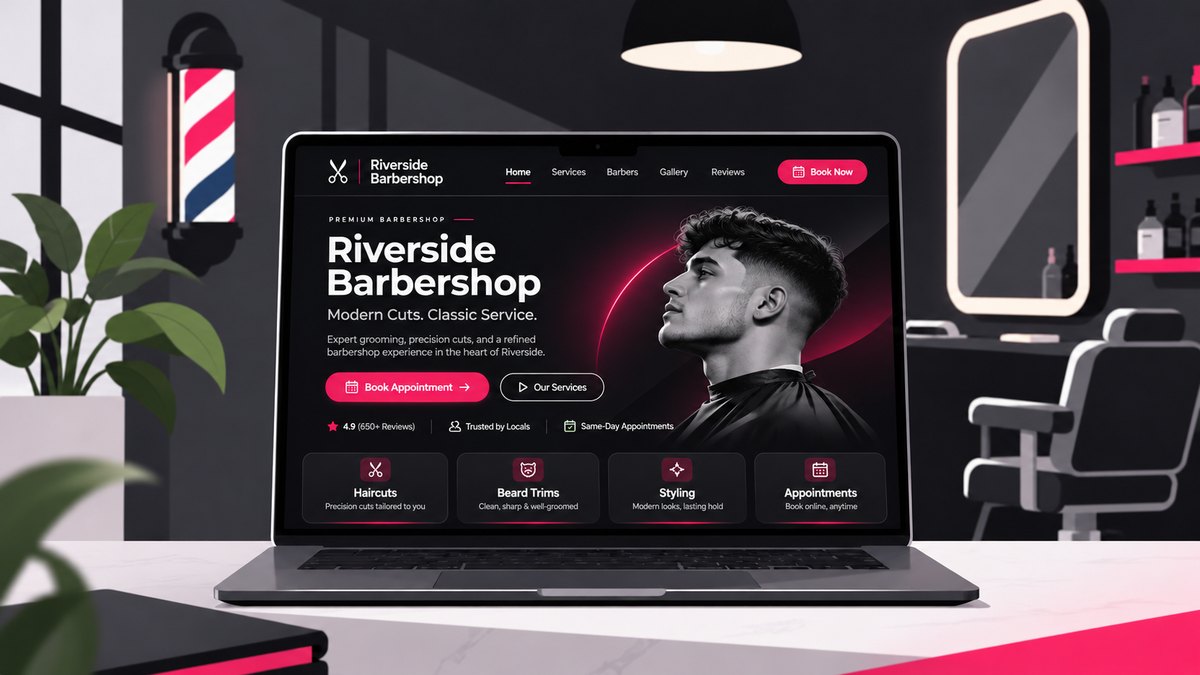
For example, a barbershop website might include:
Customers benefit because the information is accessible without unnecessary searching.
Businesses benefit because customers can make more informed decisions before reaching out.
One of the most practical benefits of a website is convenience.
A customer interested in a service shouldn't have to work unnecessarily hard to contact the business.
A website can make that process easier by providing clear calls to action.
For example:
A barbershop could connect its website to an existing appointment-booking system.
A landscaping company could include a form where homeowners describe their project and request an estimate.
An auto detailing business could organize its service packages and make appointment inquiries easy to submit.
A photographer could showcase different photography services and provide an inquiry form for potential clients.
These features won't guarantee more customers, but they can reduce unnecessary steps between discovering a business and contacting it.
Social media platforms are valuable, but businesses don't control how those platforms are designed or how their content is displayed.
Features, layouts, and algorithms can change.
A dedicated website gives business owners more control over how they present their services, brand, and important information.
You can decide what visitors see first, how your work is organized, and which actions you want customers to take.
You can also maintain a consistent brand experience through your colors, photography, typography, and messaging.
Rather than relying entirely on a third-party platform, your website becomes a central destination that you can link to from social media, directories, emails, and other marketing channels.
When people need a local service, they often turn to search engines.
They might search for phrases such as:
Having a website gives your business additional opportunities to provide relevant information that search engines may discover and display.
For example, a landscaping company could create dedicated pages describing its lawn maintenance, patio installation, and seasonal cleanup services.
These pages can help search engines understand what the business offers.
However, simply creating a website does not guarantee high Google rankings.
Search visibility also depends on factors such as useful content, technical accessibility, competition, and the accuracy of business information.
A website is one important part of building an online presence—not an automatic shortcut to the top of search results.
Not every small business needs an elaborate website.
Some businesses receive plenty of customers through referrals, returning clients, or social media.
If your existing setup already meets your customers' needs, building a large website may not be necessary.
But it's still worth considering a few questions:
Can new customers easily find accurate information about your business?
Can they quickly understand your services and see examples of your work?
Is there a simple way to book an appointment or request an estimate?
Does your online presence accurately represent the quality of your business?
If your answer to several of these questions is no, a website might be worth exploring.
The objective shouldn't be to purchase a website simply because other businesses have one.
It should be to solve a real problem for your customers.
Website costs can vary considerably depending on the provider, number of pages, design requirements, and functionality.
Some business owners assume that building a professional website requires spending thousands of dollars.
While complex websites can become expensive, smaller businesses may not need extensive custom development.
At WebFoundry, we focus on making professional website design more accessible to small businesses.
Our standard website packages currently include:
| Website Package | One-Time Price |
|---|---|
| Essential Website Package | $399 |
| Professional Website Package | $599 |
Both packages also require $35/month Website Care, which covers ongoing website services as described in our package terms.
The appropriate package depends on your business's specific needs and the features required.
Our focus is on creating professional, user-friendly websites without unnecessary complexity.
For many small businesses, the answer is yes—but the right website doesn't have to be complicated.
A website can help prospective customers understand your services, explore your work, find accurate information, and contact you more conveniently.
It can also complement your existing social media presence rather than replacing it.
Ultimately, the value of a website comes down to how well it serves both your business and your customers.
If you're considering creating your first website or improving an existing one, start by identifying the questions your customers ask most often.
Then consider whether your current online presence answers those questions clearly.
Sometimes, a few thoughtful improvements can make the experience significantly better.